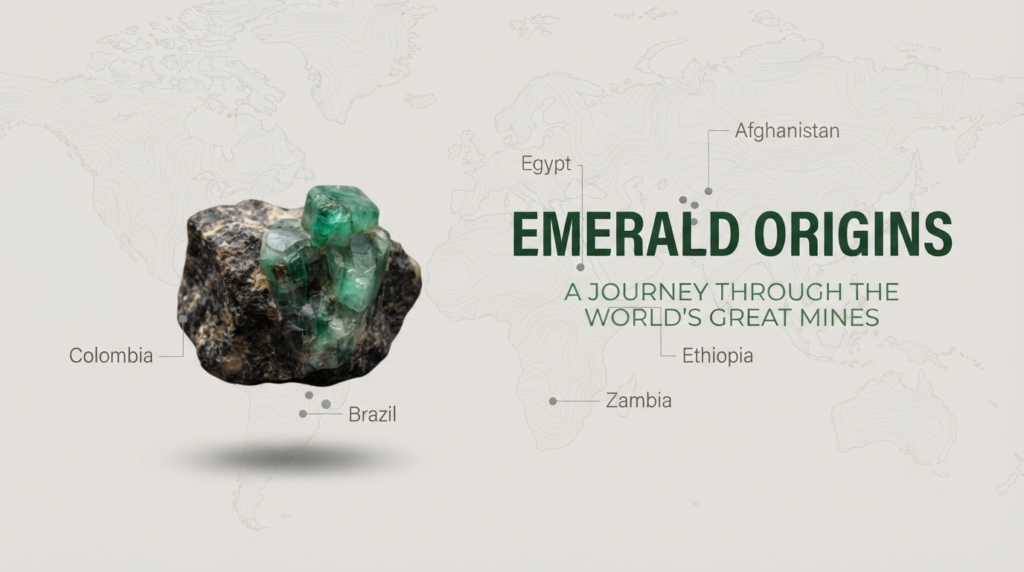
Emeralds have captivated people for thousands of years, prized not just for their vivid green color but for the remarkable range of places on Earth capable of producing it. From ancient desert mines to modern operations across three continents, the story of emerald is really a story of geography — each source leaving its own signature on the stone.
Here’s where the world’s finest emeralds come from, and what makes each source distinct.
Ancient Egypt — Where It All Began
Some of the earliest known emerald mines were in ancient Egypt’s Eastern Desert, where the stone was extracted as far back as the time of Cleopatra, who was famously fond of the gem. These mines, later known as “Cleopatra’s Mines,” were rediscovered by Western explorers in the 19th century after being lost for centuries. While no longer a major commercial source today, Egypt holds the historical distinction of being where the world’s fascination with emerald first took root.
Emerald Stone Meaning and Symbolism (Egyptian Tradition)
In ancient Egypt, emerald was linked to the goddess Isis and buried with pharaohs as a symbol of eternal youth and rebirth — a belief so enduring that the “green stone” became permanently associated with renewal in cultures that came long after.
Colombia — The Global Benchmark
Colombia remains the standard against which all other emeralds are measured. Mines such as Muzo, Chivor, and Coscuez have produced the world’s most celebrated stones, known for a strong green-to-bluish-green color that collectors and jewelers consider the finest expression of the gem. Muzo emeralds in particular are prized for their intense, slightly warmer green, while Chivor stones tend to show a cooler, more bluish tone — subtle differences that experienced buyers learn to recognize.
Zambia — Africa’s Modern Powerhouse
Zambia has emerged as one of the most important sources of emerald in the last few decades. Zambian emeralds are often darker than their Colombian counterparts, with a distinct bluish-green modifier that gives them a cooler, more saturated appearance. The Kagem mine, one of the world’s largest emerald mines by volume, is located in Zambia and has helped the country become a major global supplier.
Brazil — Range and Volume
Brazil is another significant source, producing emeralds across a wide range of shades and qualities. Brazilian emerald deposits are spread across several states, and while the finest Brazilian stones can rival other major sources in quality, the country is especially known for the sheer volume and variety it brings to the global market — making it an important source for both fine and commercial-grade material.
Pakistan & Afghanistan — Saturated Crystals from the Mountains
The Swat Valley in Pakistan and the Panjshir Valley in Afghanistan are known for producing emeralds with strong, saturated color, often extracted under difficult mining conditions in remote mountain terrain. Stones from this region can be visually striking, with a rich green that has drawn increasing attention from international buyers over the past few decades despite the challenges of sourcing from the area.
Ethiopia, Zimbabwe & Madagascar — Africa’s Newer Frontiers
Beyond Zambia, several other African nations have become notable emerald producers. Ethiopia’s deposits, discovered more recently, have gained attention for high-clarity material. Zimbabwe’s Sandawana mines were historically known for small but intensely colored crystals, and Madagascar has contributed additional supply with stones showing varied tone and saturation. Together, these sources reflect how much of the world’s emerald production has shifted toward the African continent in recent decades.
United States — North Carolina’s Emerald Legacy
Even the United States has its own emerald history. Deposits discovered in North Carolina in the 1800s still occasionally yield emerald crystals today, including some of the finest specimens ever found in the country. While not a major commercial source compared to Colombia or Zambia, North Carolina’s emeralds are a reminder that this remarkable green gem has a truly global story — turning up in places far from where most people would expect to find it.
Emerald Meaning and Symbolism
Across nearly every culture that has mined or worn it, emerald has carried a consistent thread of meaning: growth, renewal, and vitality. Its lush green color ties it naturally to spring and new life, which is why it has so often been associated with fertility and rebirth. In more modern tradition, emerald is worn as a stone of loyalty and honesty — believed to strengthen love, sharpen foresight, and bring clarity to the wearer’s judgment. Whether pulled from the deserts of Egypt, the mountains of Colombia, or the hills of Zambia, the emerald has meant roughly the same thing to nearly everyone who has ever held one: life, in its most concentrated form.
Published by Arun Moudgil on 07 August 2026