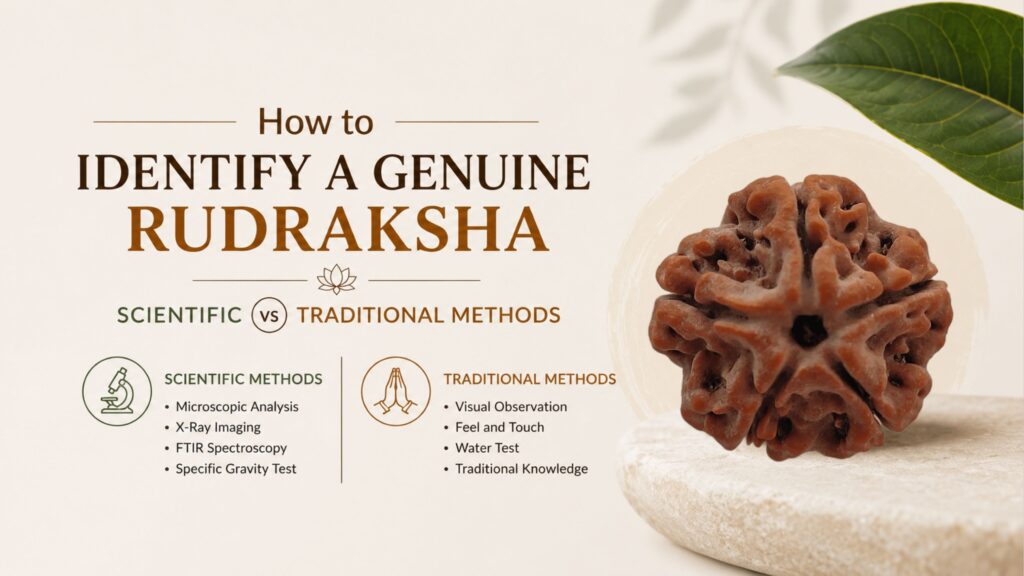
In this article, we explore both traditional and scientific approaches to identifying a genuine Rudraksha and explain why professional laboratory certification remains the most dependable solution.
Introduction
Rudraksha beads have been revered for centuries and are widely used for spiritual practices, meditation, and personal adornment. Due to their growing popularity and value, the market is flooded with artificial, manipulated, and counterfeit Rudraksha beads. As a result, identifying a genuine Rudraksha has become increasingly important for buyers, collectors, and spiritual practitioners.
Traditionally, people relied on various household tests and visual observations to determine authenticity. However, modern laboratory techniques now provide more reliable and scientific methods for Rudraksha identification.
What Is a Genuine Rudraksha?
A genuine Rudraksha is the naturally formed seed of the Elaeocarpus ganitrus tree. The surface of the bead contains natural grooves known as “Mukhis” or faces, which run from one end of the bead to the other.
Each Mukhi represents a natural compartment inside the bead. The number of these compartments determines the Mukhi classification of the Rudraksha.
Authenticity depends on:
- Natural origin
- Unaltered structure
- Genuine Mukhi formation
- Absence of artificial modifications or enhancements
Traditional Methods of Identifying Rudraksha
For generations, people have used traditional techniques to assess Rudraksha authenticity. While these methods may provide preliminary indications, they should not be considered conclusive proof.
1. Visual Inspection
The first step is careful observation.
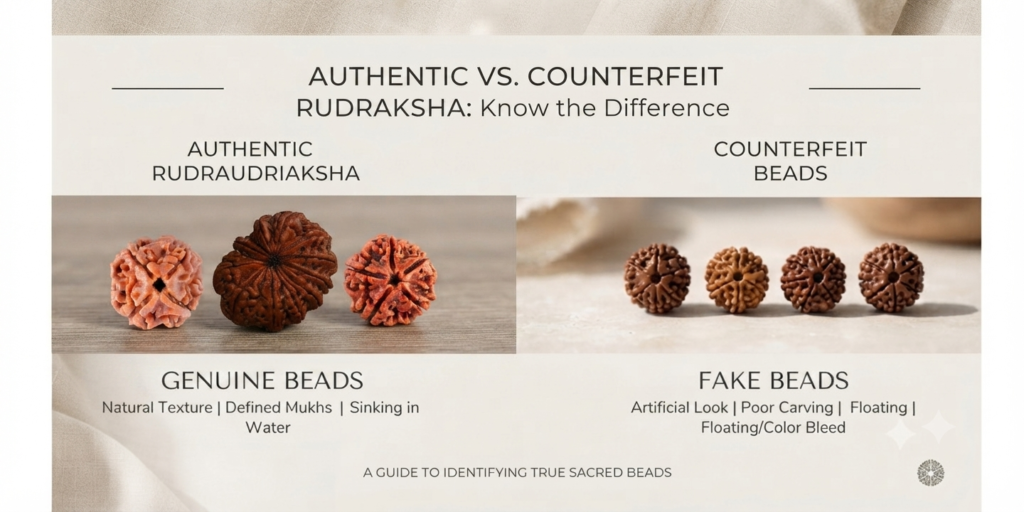
A genuine Rudraksha generally exhibits:
- Natural and continuous Mukhi lines
- Symmetrical appearance
- Well-defined texture
- Natural surface variations
Signs of potential tampering include:
- Artificial carvings
- Glued sections
- Unnatural polishing
- Suspiciously perfect grooves
However, visual inspection alone cannot confirm authenticity.
2. Water Immersion Test
One of the most commonly known traditional tests is placing the bead in water.
Many people believe:
- Genuine Rudraksha sinks.
- Fake Rudraksha floats.
This belief is not always accurate.
The sinking or floating behavior depends on factors such as:
- Density
- Internal structure
- Moisture content
- Age of the bead
Some counterfeit beads may also sink, making this test unreliable for authentication.
3. Copper Coin Rotation Test
According to traditional beliefs, a genuine Rudraksha may rotate when placed between copper coins.
However, this movement can be influenced by:
- Surface friction
- Shape of the bead
- Environmental factors
There is no scientific evidence supporting this method as a reliable authenticity test.
4. Surface Examination with a Magnifying Glass
A magnifying lens may help identify:
- Natural grooves
- Surface texture
- Signs of carving
- Artificial modifications
Although useful, this method cannot reveal the internal structure of the bead.
Limitations of Traditional Methods
Traditional tests can sometimes provide useful observations but have several limitations:
- Cannot verify internal compartments.
- Cannot detect sophisticated modifications.
- May produce inconsistent results.
- Can be influenced by environmental factors.
- Do not provide documented proof of authenticity.
As counterfeit techniques become more advanced, traditional methods alone are often insufficient.
Scientific Methods of Rudraksha Identification
Modern laboratories use advanced techniques to verify authenticity with greater accuracy and consistency.
1. X-Ray Examination
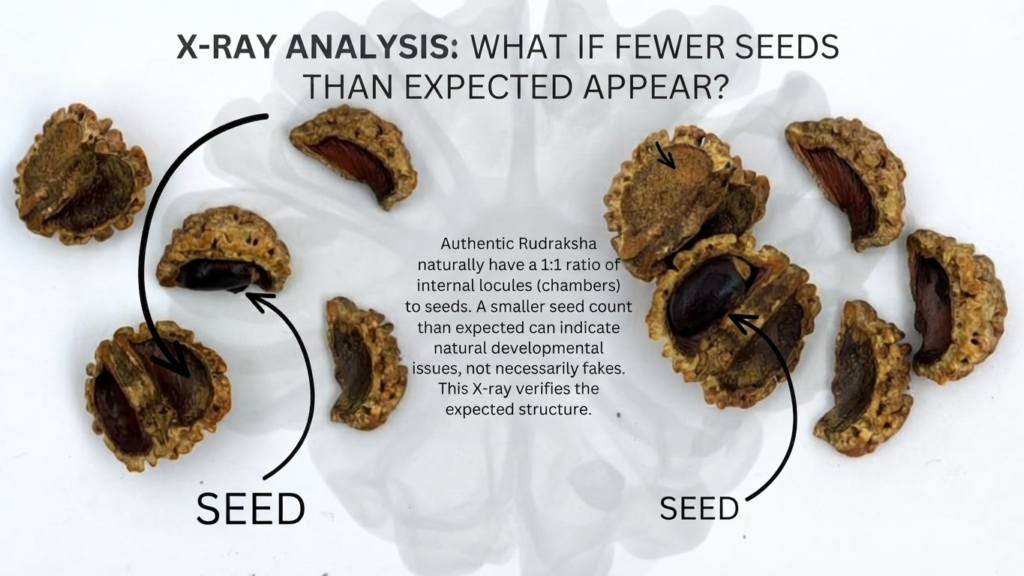
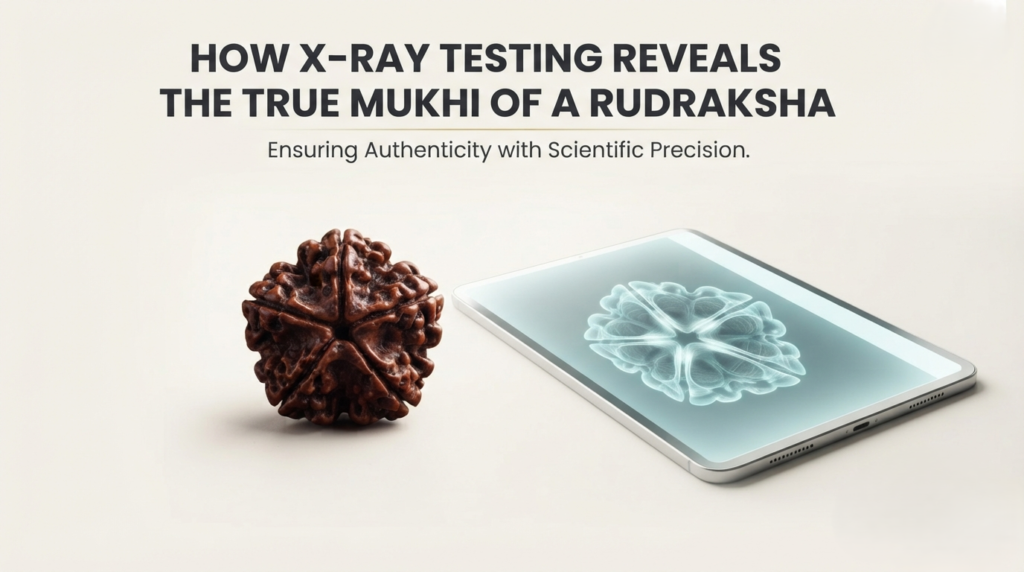
X-ray imaging is one of the most trusted methods for Rudraksha authentication.
This technique allows experts to:
- View internal compartments.
- Confirm Mukhi count.
- Detect artificial alterations.
- Identify glued or reconstructed beads.
Because each Mukhi corresponds to an internal chamber, X-ray analysis helps verify whether the external appearance matches the internal structure.
2. Microscopic Analysis
Laboratory microscopes can reveal details invisible to the naked eye.
Experts examine:
- Natural surface formations
- Growth patterns
- Artificial carving marks
- Surface treatments
Microscopic inspection helps identify tampering and structural irregularities.
3. Dimensional and Structural Evaluation
Professional laboratories record:
- Weight
- Size
- Shape
- Surface characteristics
These observations are compared with known characteristics of genuine Rudraksha specimens.
4. Documentation and Certification
After examination, a laboratory may issue a detailed report containing:
- Mukhi identification
- Bead dimensions
- Weight
- Photographs
- Testing observations
- Authentication findings
A certificate provides documented evidence that can be verified and referenced in the future.
Traditional vs Scientific Methods: A Comparison
Traditional Methods | Scientific Methods |
Easy to perform | Conducted by trained professionals |
Low cost | Requires specialized equipment |
Based on observation and beliefs | Based on measurable evidence |
Limited reliability | Higher accuracy |
No documented proof | Generates certification reports |
Cannot examine internal structure | Can analyze internal structure |
Common Misconceptions About Rudraksha Testing
Myth 1: A Genuine Rudraksha Always Sinks
Not necessarily. Density and moisture content can affect buoyancy.
Myth 2: Copper Coin Rotation Confirms Authenticity
There is no scientific evidence supporting this claim.
Myth 3: All Visible Mukhi Lines Are Genuine
Artificial carving can create misleading grooves on the bead surface.
Myth 4: Appearance Alone Determines Authenticity
Internal examination is often necessary to confirm the natural structure.
Conclusion
Identifying a genuine Rudraksha requires more than visual inspection or traditional household tests. While traditional methods may offer preliminary clues, they cannot reliably verify internal structure or detect sophisticated modifications.
Scientific examination methods such as X-ray analysis, microscopic inspection, and professional certification provide a more accurate and dependable assessment of authenticity.
For individuals seeking confidence in their purchase, laboratory testing remains the most reliable way to verify a Rudraksha’s authenticity and Mukhi classification.
Published by Arun Moudgil on 8 March 2026