
Introduction
Rudraksha beads have been revered for centuries for their spiritual significance and unique natural formation. One of the most important factors that determine the value and classification of a Rudraksha is its Mukhi (face). The number of Mukhis on a Rudraksha plays a crucial role in its identification and classification.
However, as the demand for rare Rudraksha beads has increased, so has the prevalence of artificially modified and counterfeit beads. Many Rudraksha beads may appear authentic externally but can be carved, glued, or altered to mimic rare Mukhis.
This is where X-ray testing becomes invaluable. Modern X-ray technology allows experts to examine the internal structure of a Rudraksha without damaging it, revealing the true number of natural compartments and confirming its authenticity.
What Is a Mukhi?
The term Mukhi refers to the natural grooves or lines that run from the top of the Rudraksha bead to the bottom.
Each Mukhi corresponds to a natural internal compartment within the seed. The number of these compartments determines whether the bead is classified as:
- 1 Mukhi Rudraksha
- 5 Mukhi Rudraksha
- 7 Mukhi Rudraksha
- 14 Mukhi Rudraksha
- Or any other Mukhi category
For a Rudraksha to be considered genuine, the external Mukhi lines should correspond with the internal natural chambers.
Why Visual Inspection Is Not Always Enough
Many buyers rely on visual examination when purchasing Rudraksha beads. While external observation can provide useful information, it has limitations.
A bead may appear genuine on the surface but may have:
- Artificially carved lines
- Glued sections
- Filled cracks
- Modified grooves
- Reconstructed segments
In some cases, counterfeiters alter lower-value Rudraksha beads to resemble rare and expensive varieties.
Since these modifications often affect only the outer surface, visual inspection alone cannot always reveal the truth.
What Is X-Ray Testing?
X-ray testing is a non-destructive scientific technique used to examine the internal structure of an object.
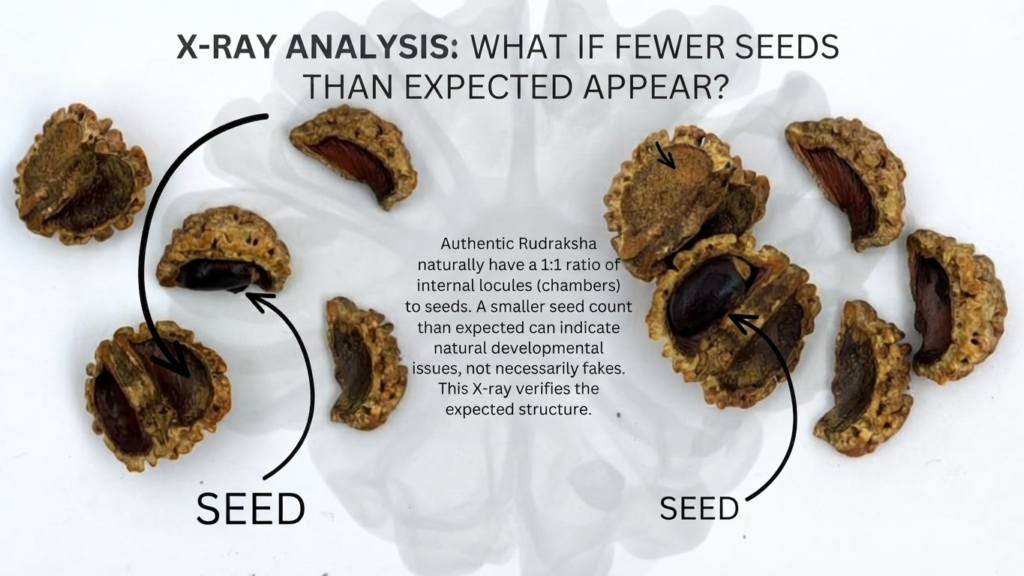
When applied to Rudraksha testing, X-rays pass through the bead and create images of its internal compartments. These images allow experts to observe the natural chamber structure hidden beneath the surface.
Unlike traditional testing methods, X-ray analysis provides direct evidence of the bead’s internal formation without causing any damage.
How X-Ray Testing Works
Step 1: Placement of the Rudraksha
The Rudraksha bead is carefully positioned inside the X-ray imaging system.
Step 2: X-Ray Exposure
A controlled beam of X-rays passes through the bead.
Different internal structures absorb X-rays differently, creating a detailed image of the seed’s internal compartments.
Step 3: Image Generation
The imaging system produces a clear view of the internal chamber arrangement.
Experts can observe:
- Number of compartments
- Structural integrity
- Natural formation patterns
- Signs of modification
Step 4: Expert Analysis
Trained professionals compare the internal chamber count with the visible Mukhi lines on the surface.
If both match, the Mukhi count is confirmed.
Step 5: Certification
After analysis, the findings are documented in a laboratory report that may include:
- Mukhi count
- X-ray image
- Dimensions
- Weight
- Authentication observations
- Certification details
How X-Ray Reveals the True Mukhi
The most important advantage of X-ray testing is its ability to verify the internal compartments of a Rudraksha.
For example:
5 Mukhi Rudraksha: A genuine 5 Mukhi Rudraksha should display five natural internal compartments corresponding to its five external grooves.
7 Mukhi Rudraksha: A genuine 7 Mukhi bead should contain seven natural internal chambers.
Rare Mukhis:
High-value Rudraksha beads such as 11 Mukhi, 13 Mukhi, or 14 Mukhi are frequently subjected to counterfeiting. X-ray examination helps verify whether these rare classifications are genuine.
Because the internal structure cannot easily be manipulated without detection, X-ray imaging provides a highly reliable method of authentication.
Detecting Artificially Modified Rudraksha
One of the major benefits of X-ray testing is its ability to identify tampering.
X-ray analysis can reveal:
Artificial Carving: Counterfeiters may carve additional lines on the surface to increase the apparent Mukhi count.
X-rays expose whether the internal chambers match the carved grooves.
Glued Rudraksha: Some fake beads are created by joining two or more Rudraksha segments together.
X-ray imaging can reveal unnatural joining patterns and adhesive zones.
Filled Cracks: Certain damaged beads may be repaired or altered using fillers.
These modifications often become visible during internal examination.
Structural Irregularities: Natural Rudraksha beads exhibit consistent internal growth patterns. Unusual structures may indicate tampering or artificial modifications.
Advantages of X-Ray Testing
Accurate Mukhi Identification: X-ray imaging confirms the true number of natural compartments inside the bead.
Non-Destructive Examination: The bead remains completely intact during testing.
Detection of Tampering: Artificial modifications that are invisible externally can often be detected.
Scientific Evidence: Results are based on observable internal structures rather than assumptions or beliefs.
Reliable Certification: Laboratory reports supported by X-ray evidence provide greater confidence to buyers and collectors.
X-Ray Testing vs Traditional Methods
Method | Can Verify Internal Structure? | Detects Tampering? | Scientific Evidence |
Visual Inspection | No | Limited | No |
Water Test | No | No | No |
Copper Coin Test | No | No | No |
Magnifying Glass | No | Limited | No |
X-Ray Testing | Yes | Yes | Yes |
This comparison clearly demonstrates why X-ray analysis is considered one of the most reliable methods for Rudraksha authentication.
Why Certification Matters
When purchasing valuable Rudraksha beads, certification provides documented proof of examination.
A professionally tested and certified Rudraksha offers:
- Verified Mukhi count
- Enhanced buyer confidence
- Protection against fraud
- Scientific documentation
- Easier future verification
For collectors, spiritual practitioners, retailers, and investors, laboratory certification adds credibility and trust.
Conclusion
Not all Rudraksha beads are what they appear to be on the surface. While traditional inspection methods may offer preliminary observations, they cannot reveal the hidden internal structure that determines a Rudraksha’s true Mukhi count.
X-ray testing provides a scientific, non-destructive, and highly reliable method for examining the internal compartments of a Rudraksha. By revealing what lies beneath the surface, it helps confirm authenticity, detect tampering, and ensure accurate Mukhi identification.
For anyone seeking confidence in the authenticity of their Rudraksha, professional X-ray testing and certification remain among the most dependable methods available today.
Published by Arun Moudgil on 04 June 2026