What If a Rudraksha Shows Fewer Seeds in an X-Ray Than Expected?
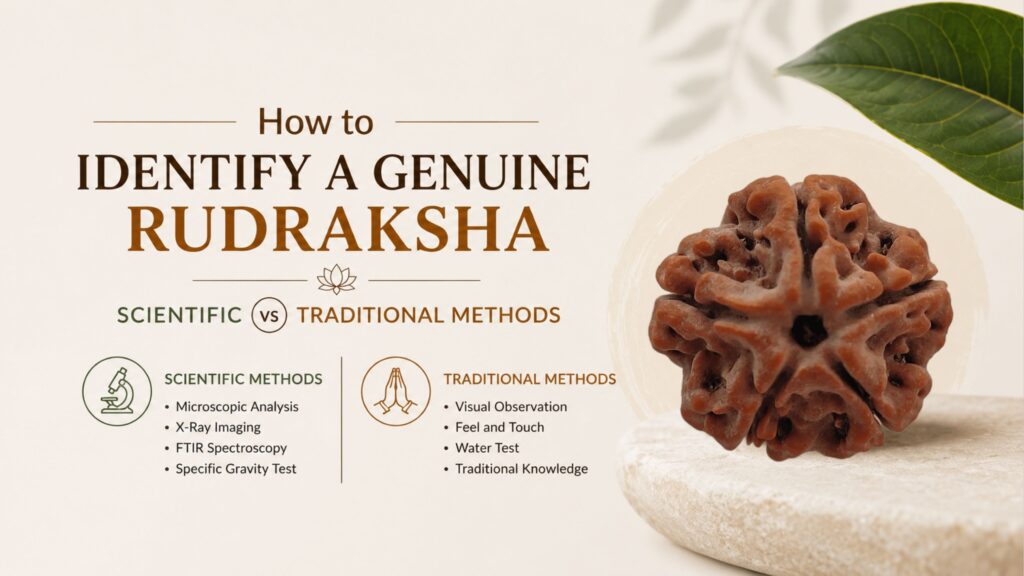
Rudraksha beads have fascinated people for centuries. Traditionally, the number of mukhis (natural grooves or clefts on the surface) determines the type of Rudraksha and its spiritual significance. However, with modern technology such as X-ray imaging, we now have the opportunity to look inside these beads and discover their internal structure.
One interesting question that often arises is:
What if a Rudraksha appears to be a 4 Mukhi from the outside, but an X-ray reveals only 2 internal seeds? Does this mean the bead is fake?
The answer is not necessarily.
Understanding the External Mukhis
The mukhis of a Rudraksha are the natural lines that run from one pole of the bead to the other. These grooves are used to classify the bead into different mukhi categories.
Traditionally, a genuine 4 Mukhi Rudraksha is identified by the presence of four continuous natural grooves. These external characteristics are the primary basis for classification.
What Does an X-Ray Actually Show?
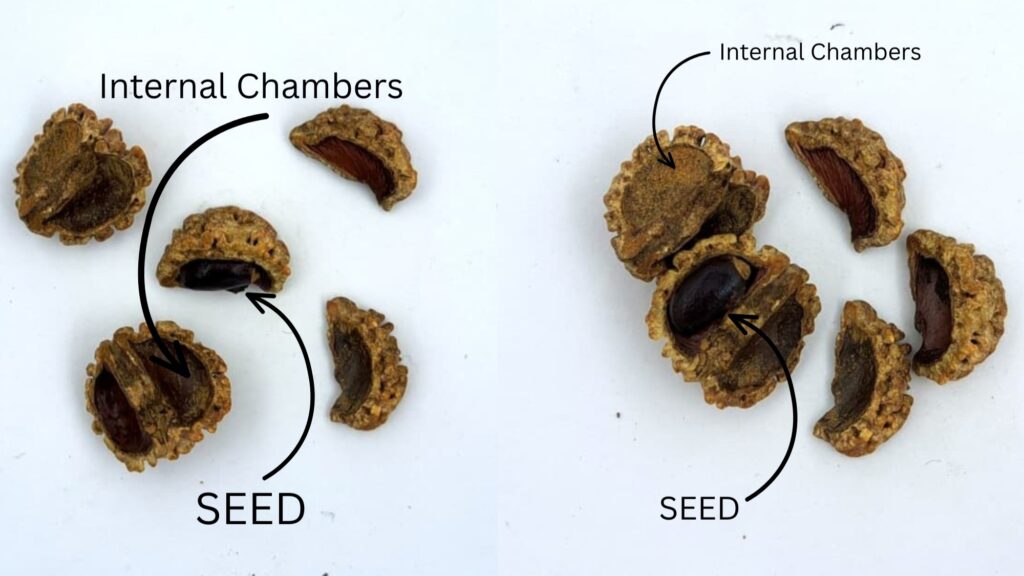
An X-ray does not display the external grooves. Instead, it reveals the internal compartments or seed structures inside the bead.
Many people assume that:
- 4 Mukhis = 4 internal seeds
- 5 Mukhis = 5 internal seeds
- 6 Mukhis = 6 internal seeds
However, nature is not always this symmetrical.
Nature Is More Complex Than Simple Mathematics
Like any natural fruit or seed, Rudraksha develops biologically. During its growth, the external grooves and the internal seed chambers may not always correspond perfectly.
Scientists studying plant anatomy know that natural variations occur because of factors such as:
- Genetic differences
- Growth conditions
- Developmental variations
- Fusion or incomplete separation of internal chambers
As a result, it is entirely possible for a bead to have:
- Four clearly visible external mukhis
- Only two prominent internal seed compartments visible on an X-ray
This does not automatically indicate that the bead is fake or artificially modified.
Why Can X-Rays Show Fewer Seeds?
There are several scientific possibilities:
- Some internal chambers may have merged during development.
- Certain seed compartments may not have fully developed.
- The orientation of the X-ray can make some chambers overlap, making them difficult to distinguish.
- Natural biological variation can produce differences between the external grooves and the internal anatomy.
These variations are common in many natural seeds and fruits and should not be considered unusual.
X-Ray Is a Helpful Tool—But Not the Only Test
X-ray imaging is valuable because it allows us to study the internal structure of a Rudraksha without damaging it. However, it should not be used as the sole method for determining authenticity.
Experts usually evaluate several factors together:
- Natural and continuous mukhi lines
- Surface texture
- Shape and formation
- Internal structure (through X-ray)
- Absence of artificial carving or tampering
Only after considering all these characteristics can a more reliable assessment be made.
X-Ray Example
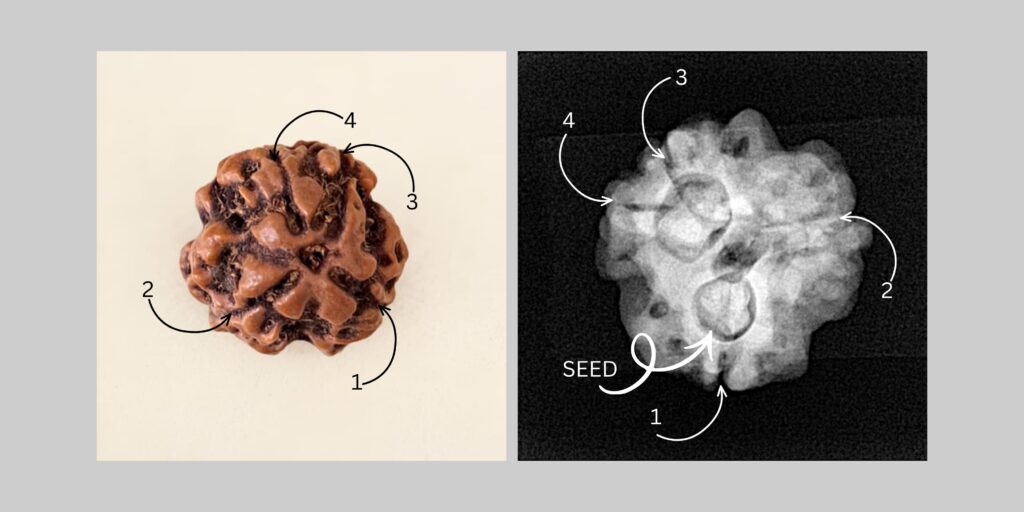
Caption: This X-ray shows a Rudraksha that has four natural external mukhis but displays two prominent internal seed chambers. This illustrates that the external classification and internal anatomy do not always have a one-to-one relationship
Final Thoughts
The beauty of Rudraksha lies in the fact that it is a natural creation. Nature does not always follow perfect geometric or numerical patterns.
An X-ray showing fewer internal seed chambers than the number of external mukhis should be viewed as a scientific observation rather than immediate evidence of forgery. External grooves and internal seed structures are related, but they may not always match exactly because of natural biological variation.
As more researchers, collectors, and enthusiasts use imaging techniques like X-rays, our understanding of Rudraksha anatomy continues to evolve. Combining traditional knowledge with modern scientific observation helps us appreciate these remarkable natural beads with greater accuracy and curiosity.